
No Wounds No Wonder
No Wounds No Wonder
“The heavens declare the glory of God, and the sky above proclaims his handiwork.”
Psalm 19:1
On April 8, more than 500,000 people will experience the “Great American Eclipse.” They will watch as the sky darkens and stars appear around a blaring corona. They will feel the temperature plummet in the shadow of the Moon. And they will listen as nocturnal creatures deliver a rare daytime performance.
Twelve million people live in the line of totality. Millions more will witness the eclipse through streaming and broadcast outlets. Scientist expect this eclipse will likely be the most photographed, most videoed, event in history. All this attention will doubtless drive “eclipse” phraseology to the top of web-searched words and solar terminology into our everyday conversations. And according to Psalm 19, this event can teach us something deep about God and his plan for us.
Here are three truths this eclipse may illuminate.
Flaws Create Beauty
Blemishes aren’t something we put out on full display, they are something we hide. We don’t want anyone to know we’ve been hurt, that we are actually damaged, that we are not perfect.
The view of the Sun’s corona is only part of the breathtaking show.
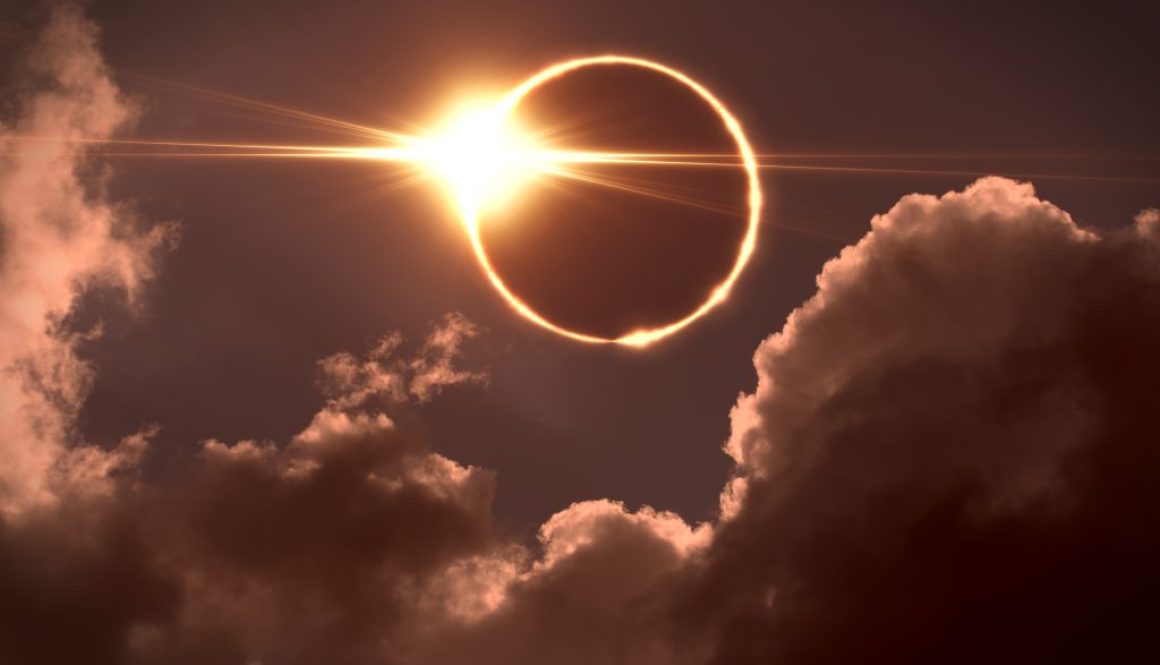
One of the most impressive features of a total eclipse is known as “diamond ring” effect. Just as our star’s corona comes into view, the entire surface of the Sun will be blocked except for one final burst of light on the trailing edge of the eclipse leading into totality (and again on the leading edge of the eclipse leading out of totality). This final burst of light creates the illusion of a sparkling diamond set on a golden ring, hence the name.
You may be interested in what is actually happening to cause this spectacle of beauty.
On Earth, layers of gas that embody the air we breathe also shield us from cosmic bombardment. Each night, the Earth is pummeled by over 5,000 bits of space debris. Some are as small as a household appliance. Others may be as large as a small automobile. Throughout the course of history, some have been much larger. As these objects enter our atmosphere, many will disintegrate as the gasses around them ignite due to friction. Others glance off the side of our atmosphere and bounce harmlessly back into space. In fact, of the 5,000 asteroids that come into contact with the earth each day, only a handful will make it to the ground because of our atmosphere.
Most of us wish we had an atmosphere. Some protective layer to shield you from bombardment. Something that might burn up the bullets, something to deflect the darts. But the hits keep coming, the scars are mounting, and you don’t know why or what good can actually come from it.
Our lives are actually more like the moon. We have no atmosphere. When the moon finds itself in the path of a celestial object, there is nothing to prevent the crash or resulting crater. It hits with the full force of its momentum and the pull of gravity. The result is millions of scars and blemishes dotting the surface. And it is these imperfections lying along the limb of the Moon that create the breathtaking image of a diamond ring.
As the Moon transits in front of the Sun, what viewers actually witness just before totality is the corona bursting through a blemish along the trailing edge of the Moon. We are essentially watching a sunrise through a lunar scar.
No blemish, no beauty.
We may not enjoy the bombardment of life, but the truth is that the blemishes in our life are precisely condition to create a spectacle of wonder. A moment when the blaring rays of God’s grace and provision can burst through some crater in our past. A breathtaking moment that would not exist without the blemishes and scars life brings us.
When the Apostle Paul lamented over a “blemish” in his life, God responded with this truth; “My grace is sufficient for you, for my power is made perfect in weakness.” In response, Paul determined to let his blemishes shine; “Therefore, I will boast all the more gladly of my weaknesses, so that the power of Christ may rest upon me” (2 Corinthians 12:9-10). This is why Paul is later able to say; “For I consider that the sufferings of this present time are not worth comparing with the glory that is to be revealed to us” (Romans 8:18).
God’s Grace Is > Than Our Sin
Struggles always appear larger in the “now.” There is something about our proximity to trouble that seems to magnify its power. As the Moon slips in front of the Sun, for a brief moment, the dominating light of our star will appear muted. Except for the corona, the cold stone surface of the moon will block out the vast illuminating rays of the Sun. But it is not the Moon’s size that creates its dominance over the light.
In our sky, the Sun and Moon have the same visible footprint. But, of course, the Moon is actually 400 times smaller. And yet, despite its cold dim inferiority, the Moon has the ability to hijack the daylight. During an eclipse, it is not the Moon’s size that will bring darkness to 12 million people. It is our proximity to it. As the Moon transits between the Earth and the Sun, it will rest 400 times closer to us than our star, thus almost perfectly eclipsing the greater power in our sky.
But even in the darkness of eclipse totality, the blaring corona reminds observers that the dominating light of the Sun radiates uninterrupted.
There are times when the light of our day is eclipsed by an unscheduled darkness. A job loss, a relationship conflict, a physical illness, perhaps even the death of a friend. Other times, our own actions may usher in darkness. As sin slips between us and the radiance of God, it may for a moment appear as great as God’s provision and grace. But this sensation is only an illusion created by our proximity to it; only a shadow of darkness. And the object that cast it cannot long blot out the immense source of light.
The darkness is not a result of the size of our struggle, but rather, only our proximity to it.
Jesus told the disciples the night before the crucifixion: “I have said these things to you, that in me you may have peace. In the world you will have tribulation. But take heart; I have overcome the world” (c.f. 1 John 3:20; Romans 5:20)
No level of human struggle can block out the loving, gracious, illuminating radiance of the Father. No matter how large they may seem at the time. John tells us that “whenever our heart condemns us, God is greater than our heart, and he knows everything” (1 John 3:20). Paul put it this way: “where sin increased, grace abounded all the more” (Romans 5:20).
Even in our darkest days, God’s grace radiates uninterrupted.
Be In Or Out
Little decisions matter.
As the shadow of the Moon makes its way from Mexico to Maine, in a 70 mile line of totality, individuals will be able to witness the full eclipse. The area under the shadow
Those inside the path will be able to enjoy the full eclipse experience. Some for just a few seconds, others for nearly 3 minutes. As is with so much of life, location is everything.
Factors like the terrain of the Moon and the terrain of the earth in the area near the eclipse path can radically affect viewing times. These variables will determine how long viewers will be treated to an eclipse, or if they will be able to witness the eclipse at all.
For the best experience, location is everything. For those outside the path, there is no dramatic moment of totality, no dance of Baily’s Beads around the edge of the moon’s disk, no intense darkening of the skies, no stars and planets suddenly revealing themselves against an impossible twilight, no corona flashing into view.
Brentwood Baptist Church in Nashville Tennessee rests right on the cusp of the southern edge of the total eclipse zone. The southern edge of the line of totality runs right through the campus of one of Nashville’s largest churches.
If one walks out the north doors of the campus at around 6:28pm on August 21, they will be treated to about 7 seconds of totality. If they were to walk out the south doors of the campus at the same time, they would be just outside the viewing area. Out one way, umbra, corona, and awe. Out the other way, an interesting spectacle, but absent of the earth shattering brilliance happening just feet away.
Little decisions matter. Close is not enough.
Little decisions matter, especially the decision to follow Jesus. Out one way, we rest in the umbra of the cross. Out the other, and we rest in the penumbra of his judgment (Romans 10:8-10).