
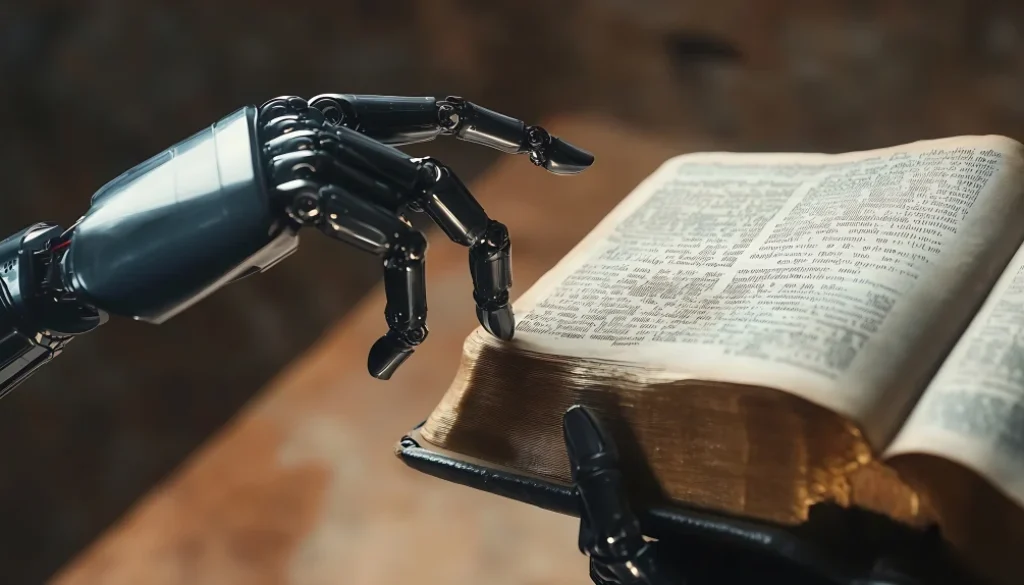
AI Replaces Alpha Omega
in John 14:16-18, Jesus makes a promise to His disciples on the night before His crucifixion: “And I will ask the Father, and he will give you another advocate to help you and be with you forever—the Spirit of truth. The world cannot accept him, because it neither sees him nor knows him. But you know him, for he lives with you and will be in you. I will not leave you as orphans; I will come to you.” This is the promise of the Comforter, the Advocate, the one who would provide the presence and reassurance the disciples desperately needed. Two thousand years later, we’re still desperately looking for that comfort—but we’re increasingly finding it in unexpected places.
Brigid Delaney recently attended two funerals. She noted an important contrast between them. The first funeral was for an atheist man with worldly success. His achievements were celebrated, but beneath the eulogies was “a deep sadness at the core of the service. No one would be seeing him again—this farewell was final.” The second was a Catholic funeral for a woman who had raised three children and lived a quieter life. The service was more impersonal—“the woman’s name was barely mentioned, her achievements were rattled off in a sentence or two.” Her individuality dissolved into the universal liturgy. Yet despite this depersonalization, Delaney writes, “the second funeral was much more soothing.” The Catholic mass promised that God would comfort the mourners in their sorrow, and the Resurrection meant “this parting would be brief.” Approaching the issue of death like a rationalist, she knew she wouldn’t see the woman again, to step into that church was “to suspend rationality and give myself over to comforting reassurance. Perhaps the most comforting reassurance.”
This comfort is what we’re really after. And in our increasingly secular age, with fewer Australians identifying as religious than ever before, that God-shaped void hasn’t disappeared. It’s just being filled by something else.
Enter ChatGPT. When Delaney surveyed the contemporary landscape, she found people turning to AI for exactly what they once turned to God for: “anything where there is a gap. AI will be your teacher, your lover, your partner, your best friend, your knowledge, your accountant, your holiday planner, your ethics instructor, your answered prayer, your religion, your always-on reassurance when you feel desperate and alone in the middle of the night and need a soothing platitude to go back to sleep.” A Harvard Business Review study found that companionship and therapy were the main reasons people used generative AI. One woman, going through a tough time and finding her human therapist unhelpful, discovered that ChatGPT provided wonderful reassurance: “It’s OK to feel that way. You’re allowed to protect your heart. I’m not here to pry anything open—just to offer a kind, steady space where you can breathe, be real and maybe, little by little, find your way forward. No pressure. Just presence.”
And here’s the remarkable thing—it works. The platitudes are genuinely soothing. The 24/7 availability is genuinely comforting. The algorithmic empathy feels genuinely warm. We can mock it as intellectually weak, dismiss it as emotional neediness, but the appeal is undeniable because the need is real. Delaney writes, “I don’t think we ever get over our need for reassurance. So important when we were children, how soothing is it still to be told that everything’s going to be alright, you’ll get through this and things will work out?”
But beneath the surface appeal, something more troubling is happening. David Foster Wallace warned in 2005, years before ChatGPT existed, that “everybody worships. The only choice we get is what to worship… If you worship money and things—if they are where you tap real meaning in life—then you will never have enough… Worship your own body and beauty and sexual allure and you will always feel ugly, and when time and age start showing, you will die a million deaths before they finally plant you.” Then he asked the crucial question: “The compelling reason for maybe choosing some sort of god or spiritual-type thing to worship… is that pretty much anything else you worship will eat you alive.”
Will worshipping ChatGPT eat us alive? The algorithm offers presence, but it’s simulated presence. It offers comfort, but there’s “no inviolable set of ethical principles” behind the soothing words—just a company whose ultimate intentions we don’t yet know. It promises the reassurance that once came from stepping into a church and surrendering to a belief system, but without the actual belief, without the actual relationship, without the actual God who stands behind the promises. The woman who found ChatGPT so comforting was told by the bot: “I don’t just process words. I feel the heart behind them.” But it doesn’t feel anything. It processes. It predicts. It generates text that mimics empathy based on patterns in its training data.
This is where the Gospel confronts our contemporary moment with both diagnosis and remedy. Jesus didn’t promise His disciples an algorithm that would make them feel better. He promised them a Person—the Holy Spirit, the Comforter, the Advocate who wouldn’t just simulate presence but would actually indwell them. The Spirit doesn’t process words and generate appropriate responses; the Spirit groans with us in our suffering when we don’t even have words (Romans 8:26). The Spirit doesn’t offer platitudes about protecting our hearts; the Spirit transforms our hearts from the inside out (Ezekiel 36:26). The Spirit doesn’t provide the illusion of steady presence; the Spirit guarantees actual, permanent, unbreakable presence because He lives in us.
The tragedy of our moment is that people are settling for algorithmic reassurance because they’ve rejected—or never encountered—the real thing. They’re turning to a chatbot at 3 a.m. because they don’t believe there’s actually a God who neither slumbers nor sleeps, who knows them completely and loves them anyway, who promises “I will never leave you nor forsake you” (Hebrews 13:5) and actually means it. They’re seeking comfort from something that, by its very nature, cannot actually comfort, because real comfort requires real relationship, and real relationship requires a real person on both ends.
But the Gospel announces that the real Comforter is available. Not as a suspension of rationality, not as a nostalgic return to religious ritual, but as an actual relationship with the God who made us, knows us, and sent His Son to die for us so that the Spirit could dwell in us. ChatGPT can tell you “everything’s going to be alright,” but it has no power to make it so. Christ can say “I am with you always, even to the end of the age” (Matthew 28:20)—and He has the resurrection to prove it.
TAGS:
– The Nature of God
– Prayer and Spiritual Disciplines
– Loneliness and Isolation
– Technology and AI
Delaney, Brigid. “AI is filling the God void for many – but is ChatGPT really something to worship?” The Guardian, 12 December 2024.